

The NZNTT is actively seeking updated information for all trees in the register. If you have information about this tree that we don't currently have recorded, or wish to advise of an inaccuracy please use our information submission form to help us build a complete profile of this tree.
Tree Information x
| Identifier: | CR/G2191 |
|---|---|
| Tree Type: | Group |
| Registered By: | Hammer, J.R., Peters I.R. |
| Registration Category: | Notable tree – National interest |
| General Notes:
|
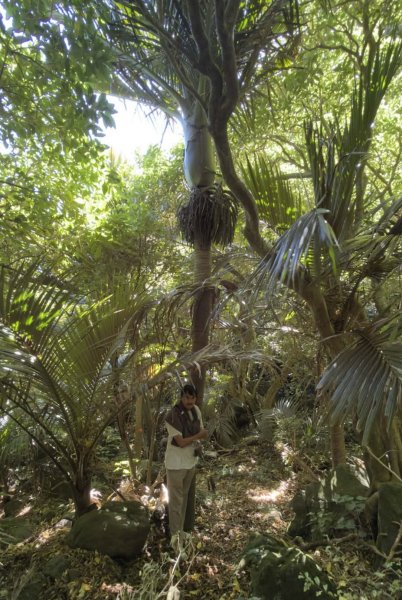
Nikau Palm Gully, near Akaroa, represents the southernmost natural remnant of nīkau palms (Rhopalostylis sapida) on mainland New Zealand. While Pitt Island in the Chatham Islands lies almost one degree further south and also supports natural nīkau populations, this gully marks the southern limit of the species on the main islands.
Approximately 180 mature nīkau palms survive within the gully, forming a nationally significant remnant population. The palms occupy a deep coastal gully with steep cliffs on both sides, terminating above the sea. This landform creates a highly sheltered microclimate that has been critical to the long-term persistence of this frost-sensitive species. Regional palaeoecological and climatic evidence indicates that during the Ōtira Glaciation (c. 75,000–14,000 years BP), much of the South Island experienced markedly colder conditions, with extensive alpine glaciation. However, coastal refugia with mild maritime climates — such as sheltered gullies on Banks Peninsula — are understood to have supported the survival of warm-temperate plant species. The nīkau palms of Nikau Palm Gully are therefore considered to have persisted through the Ōtira Ice Age within such a refugium, rather than recolonising the site following glacial retreat (Te Ara, n.d.). Access to the gully is via an approximately one-hour walk across private farmland, leading to a Department of Conservation scenic reserve. Entry is by permission only, and visitors must consult the DOC website and contact the landowner in advance. The access track passes through a landscape containing veteran mātaī (Prumnopitys taxifolia), kōwhai (Sophora spp.), and māhoe (Melicytus ramiflorus), with tītoki / New Zealand ash (Alectryon excelsus) also present along the margins. Formerly part of a working farm, the gully was gifted to the Crown by the landowners in recognition of its ecological and cultural significance, in exchange for a symbolic payment of a single 10-cent stamp presented on behalf of Her Majesty the Queen. The site is now protected as a scenic reserve, with additional covenants on neighbouring properties strengthening landscape-scale ecological connectivity. Human visitation to the gully dates back more than a century. One nīkau palm still bears a carved inscription dated 1907, providing tangible evidence of early recreational use. In the early 1900s, the population narrowly escaped destruction when several palms were felled for decoration at a social function at the Oddfellows Hall. An article in the Akaroa Mail strongly condemned the practice, warning that continued removal would result in the loss of the palms entirely and urging protection “from the hands of the Goths.” Early public advocacy and conservation sentiment were instrumental in the survival of the gully (Peninsula Tramping Club, 2021). The gully is now fully fenced to exclude grazing stock. This protection has resulted in clear and ongoing natural regeneration, with young nīkau palms establishing beneath the mature canopy. The site provides an outstanding example of the ecological benefits of fencing and stock exclusion, demonstrating improved forest structure, recruitment, and long-term viability at the southern limit of the species’ range. References 1] Peninsula Tramping Club. (2021). Nikau Palm Gully trip report. 2] Te Ara – The Encyclopedia of New Zealand. (n.d.). Glaciers and glaciation. |
Group Details
| Group Type: | Single species | |
|---|---|---|
| Feature Tree Genus: | Rhopalostylis | |
| Feature Tree Species: | sapida | |
| Feature Tree Common Names: | nikau palm, nikau | |
| QE II Covenanted: | No | |
| Given Name: | Nikau Palm Gully | |
| Actual Planting Date: | actual date not specified | |
| Approx. Planting Date: |
e.g. circa. 1860 |
|
| Current Age: | not known years | |
| Tree Health Description: | Good | |
| Local Protection Status: | No | |
| Tree Present: | Yes | |
| Number of Trees: | 180 | |
| Area Covered: | 170,000 m | |
| Group of Tree Type: | Bush Remnant |
Observations
| Date | Observer | Action |
|---|---|---|
| 21 Dec 2025 | Hammer, J.R. & Peters I.R. |
Location
|
|||||||||||||||||||||
Images
| Preview | Credit | Date |
|---|---|---|
 |
Ra Hammer | 21 Dec 2025 |
 |
Ra Hammer | 21 Dec 2025 |
 |
Ra Hammer | 21 Dec 2025 |